
Healthcare payments innovation is a key investment focus area for us at Zeal Capital Partners. Given our mission of closing the wealth, health, and skills gaps, we are active investors in healthcare payments infrastructure and solutions that improve access and affordability of care. Our portfolio company Pay Theory offers embedded payments solutions for must-pay industries, including healthcare. You can read more about their work in healthcare payments here. The healthcare payments category also closely aligns with two of our three sectors of focus: financial technology and healthcare. This article is the first in a series exploring healthcare payments. We will be sharing a variety of trends that we are watching – and what this means for innovation.
Trend #1: Rising Out-of-Pocket Expenses
Out-of-pocket expenses for healthcare have dramatically risen over time. Out-of-pocket costs are defined as the amount consumers spend on healthcare not covered by health insurance (commercial, Medicare, or Medicaid). These typically include copays, deductibles, coinsurance and other spending outside of insurance coverage, but typically don’t include insurance premiums.
To put this into context, out-of-pocket spending per person was $115 in 1970 (or, adjusted for inflation, $677). By 2022, out-of-pocket spending had reached $1,425 per person, according to the Kaiser Family Foundation. The comparable country average is $904.
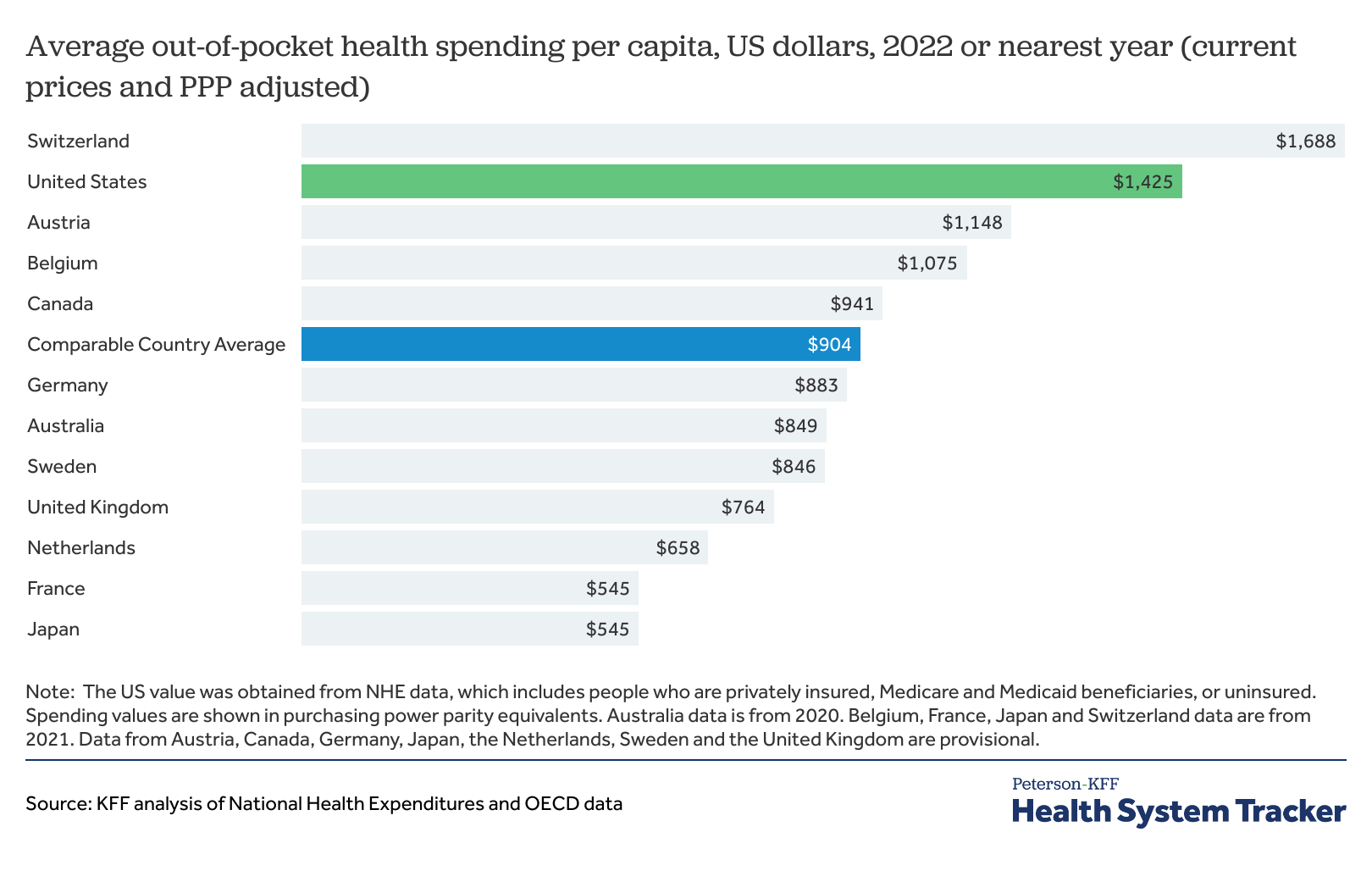
Source: Peterson-KFF Health System Tracker
Several factors have contributed to the rise of out-of-pocket expenses, including:
- Rapid growth in High Deductible Health Plans: Enrollment in High Deductible Health Plans has increased over the past decade, from 20% of covered workers in 2013 to 29% in 2023. High-deductible health plans are a type of health insurance plan that typically comes with higher deductibles and lower premiums than traditional insurance plans. The IRS has increased the minimum deductible amounts among High Deductible Health Plans from 2023 to 2024 and again from 2024 to 2025.
- Individual Coverage 2025: Minimum deductible increases by $50 to $1,650; out-of-pocket maximum rises by $250 to $8,300.
- Family Coverage 2025: Minimum deductible increases by $100 to $3,300; out-of-pocket maximum rises by $500 to $16,600.
- Higher medical prices and inflation: Medical care prices in the U.S. have historically outpaced inflation. Since 2000, the price of medical care, including services provided as well as insurance, drugs, and medical equipment, has increased by 121.3%, while prices for all consumer goods and services rose by 86.1% in the same period. Advancements in medicine and technology are further fueling this inflation.
- Aging population & Rise of Chronic Conditions: Out-of-pocket healthcare expenses tend to increase with age. Older adults spend nearly twice as much on healthcare as the general population, due to increased incidence of chronic conditions leading to a higher demand for healthcare services. People aged 55 and over account for over half of the overall health spending, but make up only 31% of the population. And nearly 20 percent of medical spending for older adults is financed out-of-pocket.
Trend #2: Boosting Telehealth and Digital Health Services
The pandemic greatly accelerated reimbursement for telehealth due to safety and health concerns with in-person visits. Given the risk around in-person visits, during the pandemic, the government allowed for parity in reimbursement between in-person and telehealth services through telehealth flexibility waivers.
Through the Consolidated Appropriations Act of 2023 and Calendar Year 2024 Physician Fee Schedule, the government extended many of the telehealth flexibility waivers through December 31, 2024. Some of the notable changes to Medicare telehealth coverage and reimbursement include:
- Location: No geographic restrictions for patients or providers
- Eligible providers: All health care providers who are eligible to bill Medicare can bill for telehealth services, including Federally Qualified Health Centers (FQHCs) and Rural Health Clinics (RHCs)
- Eligible services: See the list of telehealth services from the Centers for Medicare & Medicaid Services
- Modality: Audio-only coverage for approved services
Trend #3: Enhancing Transparency and Patient Protection
Unlike other industries, pricing in the U.S. healthcare industry has historically been opaque and complex. This lack of transparency has resulted in confusion for consumers. Though over 90% of the U.S. population has some form of health insurance, medical debt still remains a persistent issue. Unexpected medical expenses are particularly problematic for families with limited assets.
There has been a push over the last few years to enhance price transparency and protect patients from surprise medical bills. The major recent federal regulations implemented to enhance price transparency and reduce surprise medical bills are the Hospital and Payer Price Transparency Acts and the No Surprises Act.
The Price Transparency Act requires hospitals to disclose standard charges and requires insurers to disclose all negotiated rates (except for prescription drugs), while the No Surprises Act aims to protect consumers from receiving surprise medical bills from out-of-network care for emergency services and for certain scheduled services without prior patient consent.
Hospital Price Transparency Act: The Center for Medicare and Medicaid Services (CMS) issued the Hospital Price Transparency Act that became effective on January 1, 2021. This requires each hospital operating in the United States to provide clear, accessible pricing information online about the items and services they provide in two ways: (1) As a comprehensive machine-readable file with all items and services and (2) In a display of shoppable services in a consumer-friendly format. The purpose of this Price Transparency rule is to make it easier for consumers to shop and compare prices across hospitals and estimate the cost of care before going to the hospital. To enforce the rule, the CMS audits a sample of hospitals, in addition to investigating complaints that are submitted to CMS. Hospitals may face civil monetary penalties for noncompliance.
Payer Price Transparency Rule: The second price transparency rule recently implemented is the Transparency in Coverage Rule, or the “insurance price transparency rule.” This rule - which went into effect in July 2022 - requires insurers to report their full set of negotiated rates for all services except for prescription drugs (including physician-administered drugs). Many health insurance plans have data files which are very large in size (often terabytes) and contain extensive pricing information, sometimes to the point where the information is not easy to understand. There has been a push for Congress to take additional steps to make these files more consumer-friendly and usable, including eliminating “Zombie Rates” while keeping all valuable rates. “Zombie Rates” are clinically non-billable rates that can appear in health insurance payer price transparency data that can occur when a provider is listed as having rates for services that a provider has never provided. For example, a “Zombie Rate” could be a rate for a knee surgery that appears for a dentist – a rate that is not helpful for consumers.
No Surprises Act: The No Surprises Act is a federal law that became effective Jan. 1, 2022 that aims to help patients understand health care costs in advance of care and to minimize unforeseen - or surprise - medical bills. Surprise medical bills are defined as unexpected bills from an out-of-network-provider or an out-of-network facility. The aim of the No Surprises Act is to limit the amount a consumer would need to pay out of pocket to a level closer to what they would pay if the healthcare provider were in-network. The key components of the No Surprises Act are as follows:
Patients are protected from receiving surprise medical bills resulting from out-of-network care for emergency services and for certain scheduled services without prior patient consent.
For example, let’s say a consumer has a surgery at a hospital or outpatient surgery center in their health insurer network, but the anesthesiologist who provided care was out-of-network. The consumer then receives an out-of-network bill for the anesthesiology services. This is considered a surprise bill. The provider cannot charge more than the consumer would need to pay for an in-network doctor. Under the No Surprises Act, if a health plan denies all or part of a claim for a service, consumers can appeal that decision if they receive a “balance bill” for certain out-of-network services.
Patients who do not have insurance or who are not using insurance to pay for care have a right to receive a good faith estimate of their potential bill for medical services when scheduled at least three days in advance. If an uninsured patient receives a healthcare service and the billed amount is $400 above the good faith estimate, then they may be able to dispute the charges with an independent third party reviewing the bill and determining the appropriate payment.
Three key trends - rising out-of-pocket costs, increase in telehealth and digital services, and new regulations around price transparency and patient protection - create the tailwinds for significant opportunity to improve healthcare payments. These underlying shifts have started to transform how consumers shop for, access, and pay for their healthcare. For example, in response to rising out-of-pocket costs, startups have emerged to help patients access and use their HSA/FSA funds like Binkey and Sika Health. Other companies have helped health insurance companies and providers comply with the new Price Transparency rules or help employers benefit from these regulations, including Turquoise Health, Handl Health, and Serif Health. Zeal portfolio company Pay Theory offers an end-to-end payments platform to help healthcare organizations and consumers navigate these trends and regulatory changes. We look forward to delving into innovative opportunities in digital payments in our next article.